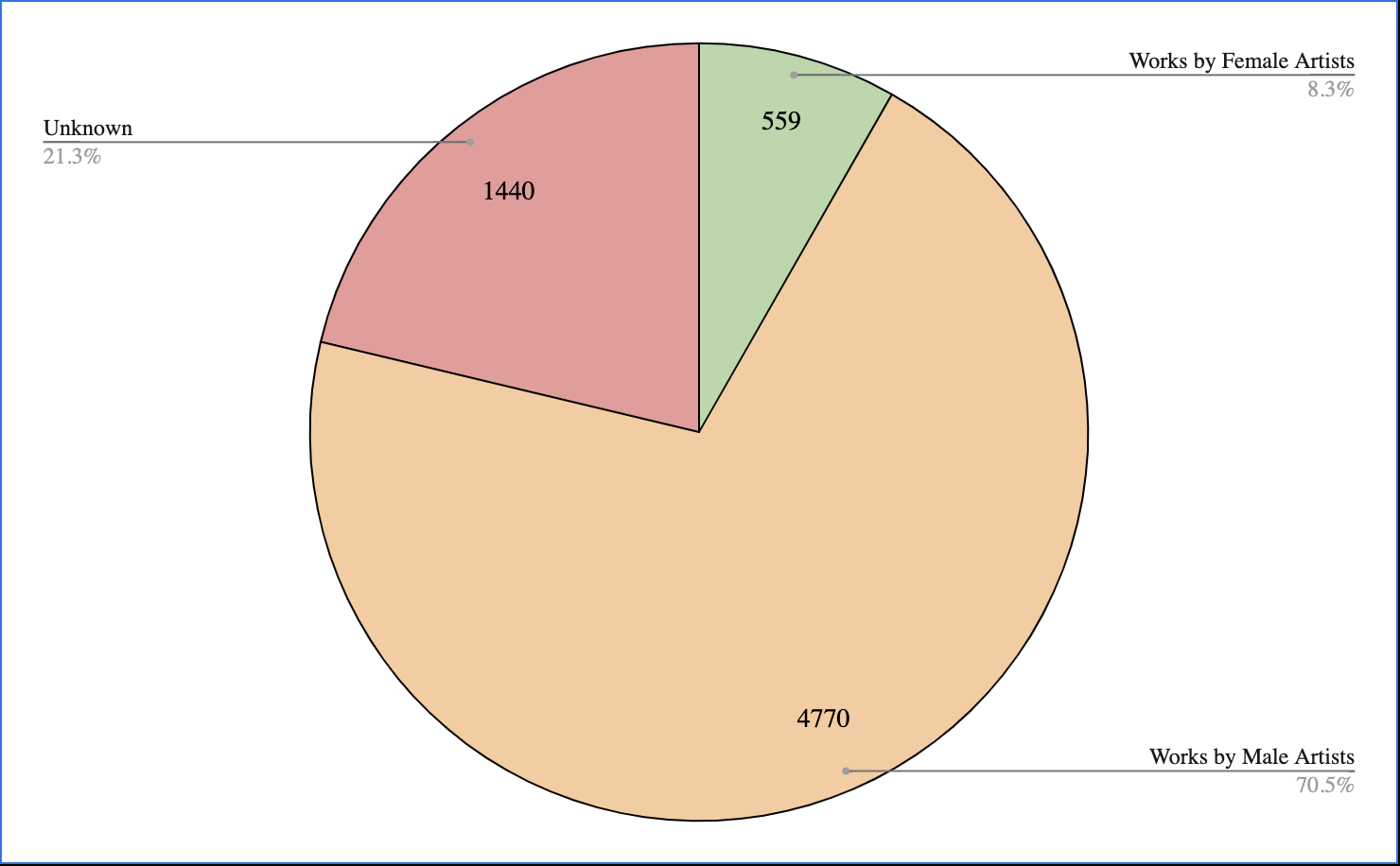
At Florida State University’s Museum of Fine Arts (MoFA), only 8% of the permanent collection represents works by female artists.
Museum of Fine Arts Data Gender Statistics
This platform is for all female artists who have been overlooked
A Note From the Curators
Curatorial identity and ethics make a large difference for the diversification of our museum galleries. Curatorial Activist, Maura Reilly, begs the question “How can we get people in the art world to think about gender, race, and sexuality, to understand that these are persistent concerns that require action?” Curators in our day in age, while facing discrimination of gender, race, and sexuality in the art world, need to become aware of what all artists are doing, what they’re interested in, and know that it is quite different to what white male artists are doing. Reilly writes, “It is disheartenig that so may art professionals who have the power to istitute change often do nothing to counter overt discrimination against Other artists, esspecially when that work is readily available.” Through our process of curating this digital exhibition, we kept these values in mind and let them guide us to an ethical curatorial practice in order to provide a platform for underrepresented female artists.
Gender disparity can be seen in different areas of our society, including in art museums all across the globe. the United States Census recording over 50% of the United State population as female, our museum collections should reflect that. According to the National Museum of Women in the Arts, in a study of 820,000 exhibitions across the public and commercial sectors in 2018, only one third were by women artists. In a study conducted by mathematicians, statisticians, and art historians at Williams College, the United States’ art museum sector is grappling with diversity. The study showed that 18 major museums in the United States are 85% white and 87% male within the permanent collections. At the Metropolitan Museum of Art, for instance, less than 3% of the artists in the modern sections are women, but 83% of nudes are of women. The Andrew W. Mellon Foundation: Art Museum Staff Demographic survey states, “the case is clear and urgent, and constructive responses to it will be critical to the continued vitality of art museums as public resources for a democratic society.”
However, more and more recently, we have seen curators who are creating spaces that encourage dialogue of hard truths and activism within their communities in order to provide a platform for minority artists who have been pushed to the side and ignored.. These curators are people who are stretching in exciting, innovative, and creative ways in what curatorial work actually is and can be. Inspired by the curators who stand before us and activism groups such as the Guerilla Girls, who provide a platform for these hard truths and realities, we have created an exhibition that provides a space for female artists who have been stripped of their artistic voice. Our particular exhibition uses pieces of the permanent collection at Florida State University’s Museum of Fine Arts (MoFA). These pieces were selected after careful statistical research that showed only 8% of the works in the museum’s permanent collection were by female artists.
Because the MoFA is a university housed institution, it faces many obstacles when it comes to funding and the acquisition of new works of art. With a small acquisitions budget, many of the works within the permanent collection are donations from individuals within the Florida State community such as recent graduates from FSU BFA and MFA programs. The institution’s acquisition guidelines outline that recommendations for purchases and gifts will be considered for acquisition if the objects meet one of the following requirements:
- Objects are of instructional value consonant with the Museum’s mission and intended for academic study or research.
- The purchase/gift has a valid connection with the Museum’s conscious effort to preserve the history of artists in this geographical region, especially faculty artists.
- The objects relate to exhibitions organized by the Museum in its efforts to present programs of excellence and observe equity.
- Objects are of aesthetic excellence. Whether or not an object meets these requirements is up to the faculty within the College of Fine Arts (Department of Art History, Department of Art) and the Museum staff, as well as relevant department heads from the Advisory Council. Senior Registrar and Collections Manager, Jean Young, has held this position for over 20 years and has observed the nature of the acquisition process. Young speaks on the expansion of the collection, “Due to storage issues, the Museum currently has no plans to extensively expand their collection, with the possible exception of outstanding works offered as a donation or works that correspond to a curated exhibition at the Museum.”
The acquisition guideline also states, ”The Museum of Fine Arts is empowered by its mission statement to collect the widest possible range of high-quality works of art from the most ancient to the most avant-garde, from all the world’s cultures past and present in all visual arts media. Notwithstanding the broad collection objective, for the time being, resources will be allocated to artworks that build upon current Permanent Collection strengths.” While abiding by these acquisition guidelines, the MoFA has created a gender disparity within their permanent collection, but we have outlined a number of ideas the museum can work towards. We do, however, recognize the lack of resources the MoFA faces, but we believe that even with lack of resources there are improvements that can be made. One of the most progressive steps an institution can make towards decolonial practices is to acknowledge their own gender gap within the permanent collection. The MoFA could go about this in a number of ways, one being to publish the statistics of their permanent collection on the museum website, along with a statement or diversity clause that details the museum’s views on gender disparity. With an increased budget, the MoFA could make considerable steps such as planning solo female exhibitions and acquiring more works by female artists.
However, by also providing information detailing their particular accession process, fundraise for works by female artists, and encourage the female students within the BFA and MFA programs at Florida State University would be realistic given the MoFA’s current capabilities. If considered, this call to action could result in a big step towards limiting the gender disparity that is so prevalent in the MoFA’s permanent collection. Furthermore, it is a small part in the continuation of the work that curators and activists are taking part in across the globe to create more decolonized and equitable museum institutions.
-Stephanie Fischer and Gabrielle Abbosh